
News
New in the team:
Dr. Maren Runschke
With a focus on cosmetic dentistry, Dr. Runschke is taking over from our longtime colleague and partner, Dr. Sabine Baron. Thanks to extensive specialized training both in Germany and abroad, she is highly specialized in the field of dental prosthetics.

New in the team:
Kids doctor Gela von Schutzbar
Ms. Gela von Schutzbar, a pediatric dentist, joins our team. Her areas of expertise include relaxation and sedation techniques, treatment with nitrous oxide—safe and anxiety-free—and, if necessary, under general anesthesia, the placement of baby tooth crowns for severely decayed teeth, and the treatment of MIH teeth (“chalky teeth”) using gentle methods. When treating children with special needs, Ms. von Schutzbar draws on her many years of experience and her exceptional empathy.

IN WELL-DESERVED RETIREMENT:
Christof Riffel
Our longtime partner and colleague, Christof Riffel, has been retired since February 2026 after many years as a beloved and successful pediatric dentist.
Klinische Studie belegt:
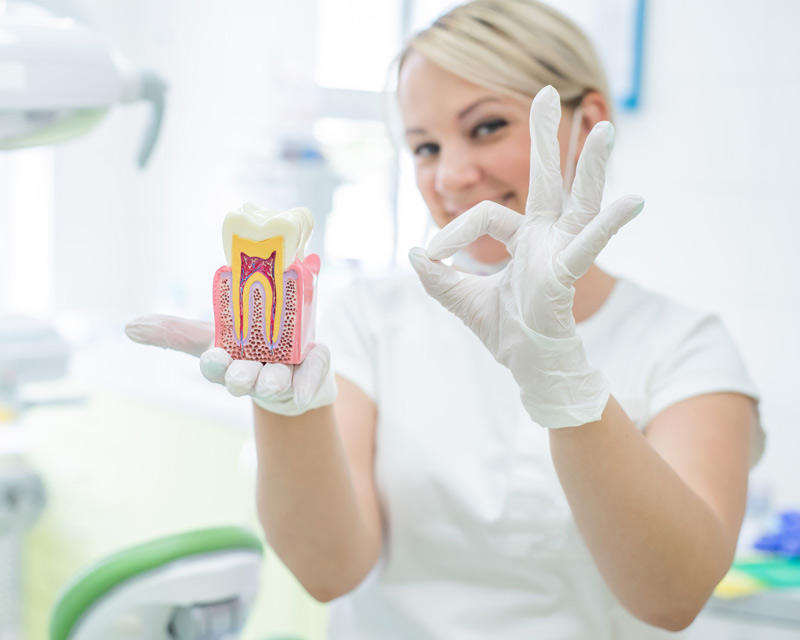
Root canal treatments promote health
Study by King’s College London proves long-term effect
“Health begins in the mouth” is an old saying. But the reverse is also true: “sick” can also start in the mouth. According to the World Health Organization (WHO), around 3.7 billion people worldwide are affected by untreated oral health conditions — above all tooth decay. With serious consequences for general health.
A new study now shows that successful root canal treatment for inflammation of the tooth roots not only benefits dental health, but can also have positive effects on general health.
In a clinical study, King’s College London analyzed the changes in certain blood values following root canal treatment due to apical periodontitis — an inflammation at the tip of the root. If left untreated, such an infection can lead to serious secondary diseases.
“Prolonged root canal infections can contribute to elevated blood sugar and fat levels — factors that increase the risk of serious health problems,” explains endodontist Sadia Niazi, lead author of the study at King’s College.
The current study was the first to investigate how successful root canal treatment affects heart and metabolic health. Sadia Niazi and her team followed the health of 65 patients after endodontic treatment over a period of two years. Using nuclear magnetic resonance spectroscopy, the researchers analyzed various blood molecules to understand how the body processes sugar and fats and reacts to diseases and medical interventions.
The evaluation showed clear correlations: after successful root canal treatment, the patients’ blood sugar levels fell significantly over the two years — a key factor in preventing diabetes. The team also found short-term improvements in cholesterol and fatty acid levels, which are closely linked to heart health. Important inflammatory markers, which increase the risk of cardiovascular disease and other chronic conditions, also decreased over the course of the observation period.

Feeling Comfortable at the Dentist
“Anxious Patients” – that Was Yesterday!
The Praxis am Kureck specializes in dealing with “dental anxiety” and “uneasy feelings.” The pleasant, calm atmosphere of the practice, the organization, and the training of the doctors and assistants ensure a feeling of well-being and security – before and after treatment. Read an article from Vivart magazine here.

Dental Cleaning Flat Rate
Healthy, Well-Maintained, and Money Saved!
Regular care and professional teeth cleaning can keep your teeth fit for life. Unfortunately, many health insurance companies do not cover these costs. We therefore recommend taking out a low-cost supplementary insurance policy such as “Zahnidee” (zahnidee.de). For €15.80/month, many services are covered 100%.
More information on the website Zahnidee

Dental Association Protests
Dental Practices are Suffocating in Bureaucracy!
The government’s regulatory frenzy is increasingly spreading. Dentists already spend a quarter of their time filling out lists and forms. See a report by the Berlin chairman of the dental association, Dr. Karsten Hegewaldt, on Sat1 breakfast television.

Amalgam Ban from 2025:
What Does that Mean for You?
Dear patients,
since January 1, 2025, the use of amalgam as a dental filling material has been prohibited in the EU for ecological and health reasons. In this article, we explain what amalgam is, why it is being banned, and what alternatives are available to you.
What is Amalgam?
Amalgam is a dental filling material that has been used worldwide for over 150 years. It consists of approximately 50% mercury, combined with other metals such as silver, copper, and tin. Amalgam has long been popular because it is robust, durable, and cost-effective.
Why is Amalgam Being Banned?
The main component of amalgam is mercury, a toxic heavy metal that pollutes the environment, especially when old fillings are not disposed of properly. Health concerns also play a role. It is suspected that amalgam fillings are harmful to the health of some people, even if there is no clear scientific evidence for this. Nevertheless, the use of mercury has been repeatedly criticized for some decades. Pregnant women, breastfeeding mothers and children have already been excluded from use in recent years.
From 2025, no new amalgam fillings may be used in Germany. The good news: old amalgam fillings do not have to be removed as long as they are intact. They can easily last for several decades.
What Alternatives are there?
Modern dentistry offers several alternatives to amalgam that are safe, aesthetically pleasing, and durable:
- Composite fillings (plastic): These fillings are tooth-colored and therefore almost invisible. They are particularly suitable for small to medium-sized defects.
- Ceramic fillings: Ceramic is very durable and visually barely distinguishable from natural teeth. This solution is particularly suitable for larger fillings.
- Gold inlays: Gold is extremely durable and biocompatible, but more expensive and visually more noticeable.
- Glass ionomer cement (GIC): These fillings are primarily suitable as a temporary solution or for smaller defects.
For inexpensive alternative filling materials such as self-adhesive plastics or glass ionomer cement, the statutory health insurance companies will cover the costs from 2025. However, these materials only last about 5 years on average.
Do I Have to Have My Amalgam Fillings Removed Now?
No. Amalgam fillings that are intact and do not cause problems do not need to be replaced. Replacement is only necessary if the filling is leaky.
If you decide against amalgam for personal reasons or would like to have existing fillings removed, we would be happy to discuss the best alternatives with you. For example, you can use higher-quality materials such as composite or ceramic fillings. These cost extra, but offer a durability of up to 15 years or more. The surcharge depends on the size and position of the filling.
OUR RECOMMENDATION
The ban on amalgam is an important step for the protection of the environment and offers you the opportunity to benefit from modern, high-quality filling materials. Feel free to contact us at your next visit about possible alternatives or your existing fillings. Together we will find the best solution for your dental health! Your team at Praxis am Kureck

Awards
“Stern” Seal of Approval, Focus List and Praxisplus–Award
In the special issue “Good Doctors for Me” 2025, the magazine stern recommends the best specialists in Germany. Praxis am Kureck is also represented this year with three doctors: Dr. Marco Georgi, Dr. Henning Bahnemann and Christof Riffel are recommended in the current “stern” special issue “Good Doctors for Me 2025”.
The three doctors are also listed as recommendable in the focus list of the best physicians.
For the management of the practice and patient communication, the Praxis am Kureck received the “Praxisplus-Award” with 5 stars again in 2025.