
PAIN COMPASS
Brief Sensitivity to Hot or Cold
Possible cause:
A brief sensitivity to hot and cold does not have to be a sign of a serious problem. The sensitivity may be due to a loose filling or minimal gum recession that exposes a small piece of the root surface.
What can be done?
Try a toothpaste for sensitive teeth. Only brush your teeth in an up-and-down motion, ideally only from the gums to the teeth (from red to white). Strong sideways movements lead to wear and tear of the root surface. If all of this is unsuccessful, consult your dentist.
Stabbing Pain when Chewing
Possible cause:
There can be a variety of reasons for this type of pain that lead to tooth sensitivity; this can be, for example, a cavity, a loose filling or a crack in the tooth. This can then lead to damage to the pulp (nerve).
What can be done?
To find out the exact cause, please visit your dentist. A crack in the tooth can also lead to damage to the tooth nerve and can be treated by an endodontist (specialist in root canal treatment) with a root canal treatment.
Constant and severe pain with pressure. Swelling of the gums. Sensitivity to touch
Possible cause:
One of your teeth probably has a festering process that leads to infection of the surrounding bone.
What can be done?
Visit your dentist or endodontist (specialist in root canal treatment). He can help preserve the tooth. Take painkillers until the treatment appointment.
Chronic Pain in the Head, Neck or Ear
Possible cause:
Sometimes teeth whose pulp (nerve) is damaged are the cause of such pain. This pain often occurs in other areas of the head and neck. However, other general or dental problems can also be responsible for this.
What can be done?
Consult your dentist or endodontist (specialist in root canal treatment) for a thorough examination. If it is not a dental problem, he will recommend a further examination by your general practitioner.
Hypersensitive Tooth Necks
Possible cause:
- Exposed tooth necks after gum recession, often one with notch-shaped cavities
- too vigorous horizontal brushing
- Nightly grinding and overloading of the tooth
What can be done?
- Reduction of sensitivity with varnish-like coatings
- Filling of the notch-shaped cavities
- Reduction of the load on the tooth by grinding or wearing a bite splint
- Plastic displacement of the gums to cover the exposed tooth neck
Tooth Migration
When teeth start to migrate, i.e. when they change their position, rotate, tilt or start to “grow”, this often leads to undesirable changes. Gaps appear or individual teeth become longer or crooked. The result: food residues are more likely to get caught in the new niches, which are also more difficult to clean.
This can then happen when the foundation of the teeth becomes weaker. Inflammation that leads to bone loss is usually responsible for this. However, constantly acting forces can also cause teeth to migrate. This includes, for example, constant nightly grinding.
Possible cause:
- tooth foundation weakened by bone loss
- Teeth grinding
- constant chewing on e.g. pipe or ballpoint pen
What can be done?
- Gum treatment
- Wearing a bite splint (occlusal splint) Shifting the teeth into the desired position (orthodontics)
- small changes to the tooth shape through “esthetic contouring” or ceramic shells (laminate veneers)
- larger changes with crowns and bridges
Sensitivity to Hot or Cold after Dental Treatment
Possible cause:
The nerve inside your tooth may be temporarily irritated by dental treatment. This can lead to temporary sensitivity of the tooth.
What can be done?
Please wait up to 6 weeks. If the sensitivity persists or worsens, please contact your dentist.
Persistent Pain after Hot or Cold Food
Possible cause:
The pulp (nerve) of your tooth is probably damaged by a deep cavity or by physical trauma (blow, fall, etc.).
What can be done?
Visit your dentist or endodontist (specialist in root canal treatment). A root canal treatment will probably be necessary to preserve the tooth.
Dull Pain and Pressure in the Upper Jaw Area
Possible cause:
The symptoms of sinusitis (inflammation of the paranasal sinuses) could feel like this. It is also possible that the consequences of severe teeth grinding (bruxism) manifest themselves in this way.
What can be done?
If you suspect sinusitis, you can initially help yourself with painkillers and medication for sinusitis and see your ENT doctor or family doctor as soon as possible. If nightly teeth grinding is your problem, please contact your dentist.
Pain from a Dental Accident (E.G.: Child Has Fallen)
Immediate Measures
- Is the child conscious? – If not, call an ambulance immediately!
- Does your child have other serious head wounds? – If so, call an ambulance!
- Is he dizzy or nauseous? – If so, go to the clinic!
- Is there a tetanus vaccination? – If not, inform the doctor!

The lost tooth can be stored in the tooth rescue box for up to 48 hours.
Further Measures
Once these first important points have been clarified, the following first steps should be taken in the event of a pure dental accident:
- Search for and recover the tooth or tooth fragment!
- Only touch the tooth crown, the root surface must not be touched!
- Do not clean! Do not remove dirt particles adhering to the tooth! Do not disinfect the tooth!
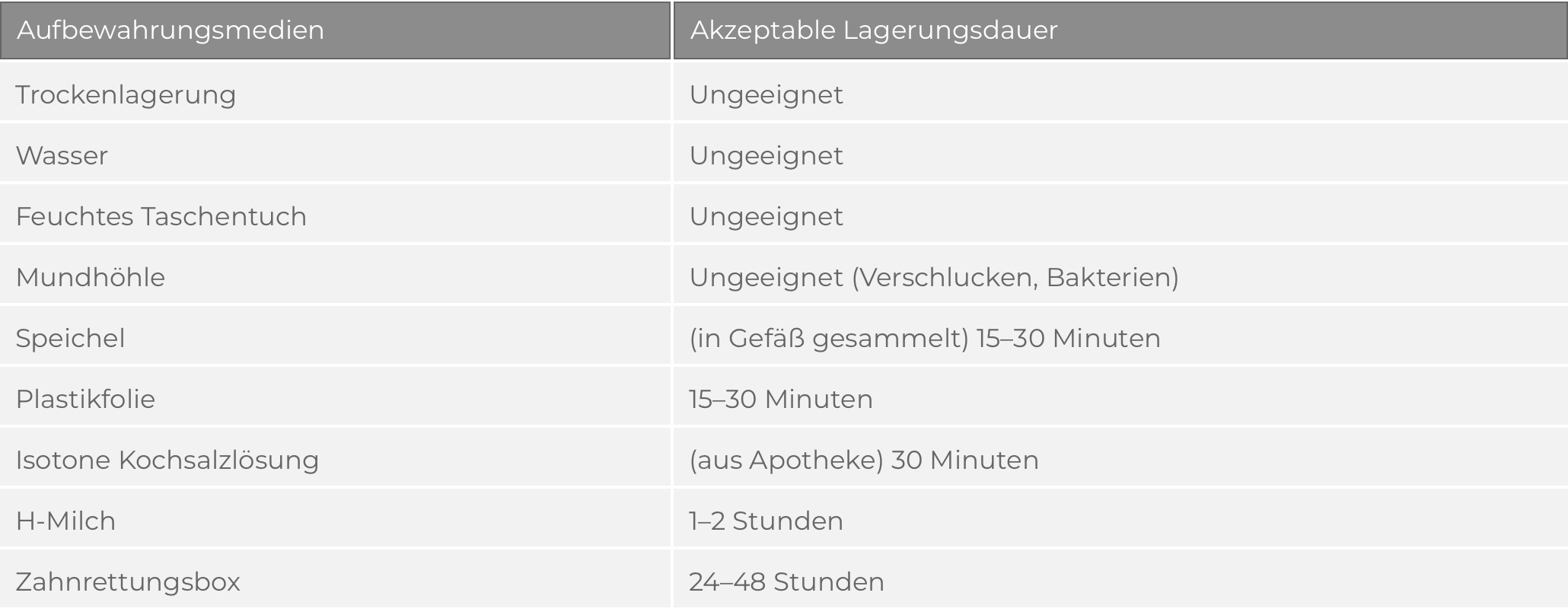
- Do not allow to dry out! Keep the tooth moist: it is best to put it in the tooth rescue box (storage period 24–48 hours). If you do not have one at hand, you can also put the fragment in UHT milk (storage period 1–2 hours max.)
- Go to the dentist or dental clinic as soon as possible! The documentation there is also important for any insurance claims.
TIP: For children who are very active in sports, think about protective equipment and mouthguards.
Bleeding Gums
The tendency to bleed even with careful touching is an indication of a disease of the gums. In most cases, this is an inflammation caused by microorganisms. In order to largely eliminate these, an intensive, professional teeth cleaning is always necessary. Here, the teeth are freed from all hard and soft deposits. These not only discolor the teeth, but also provide shelter for the microorganisms.
Possible cause:
- Microorganisms
- Hard and soft plaque
- protruding edges of crowns and fillings
What can be done?
- intensive professional teeth cleaning
- Treatment of the periodontium in advanced cases
- if necessary: renewal of crowns and fillings
Dental Accident – What to Do?
In emergencies, please try to reach us immediately: 069 977 769 8–0. You will get an appointment very quickly! If you cannot reach us, please dial the nationwide dental accident emergency number: +49 (1805) 012800 (€0.14/min. from a landline, German mobile network max. €0.42/min.)
Often a piece of tooth is broken off or a tooth is completely knocked out. Then you should see a dentist as soon as possible. He can reattach broken pieces of teeth with a special plastic. He can reinsert a knocked-out tooth.
1. Act quickly: search for the tooth / tooth fragment immediately.
Only touch the knocked-out tooth by the tooth crown, not by the root.
2. Do not clean or disinfect.
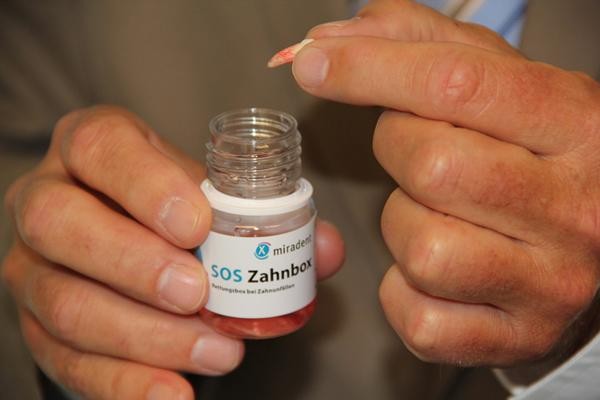
3. Immediately place the tooth in the tooth rescue box.
4. In case of heavy bleeding, press gauze or a clean, lint-free piece of textile (e.g., a cloth handkerchief) onto the wound, and cool externally.
5. Seek a dental practice / dental clinic as quickly as possible.
If no tooth rescue box is available nearby, the second best solution is UHT milk*
*(for a maximum of 12 hours, healing outcome is worse), therefore transfer the tooth to a tooth rescue box as quickly as possible.
A tooth rescue box often provides crucial help for the tooth’s survival. Knocked-out teeth dry out within a few minutes without precautions.
The Tooth Rescue Box
…contains a special cell nutrient solution: It prevents the tooth from drying out and allows the cells to survive for 24 to 48 hours.
The nationwide scientifically supported project Zahnrettungskonzept.info places dental rescue boxes at accident-prone locations. There are currently over 18,000 locations in the database. On this website, you will find locations where you can obtain a tooth rescue box.
Storage Media Comparison
If no tooth rescue box is available after a dental accident, other storage options can also be considered as a temporary measure. However, they cannot prevent the continuous death of cells, but only delay it for a short time. Therefore, they should be replaced with a tooth rescue box as quickly as possible.
Holistic Pain Therapy
Where Does My “Toothache” Come from?
There are pains in the teeth that do not have dental causes. Such pains can only be diagnosed and treated if all known factors are considered within the framework of a “holistic pain therapy”.
This brochure generally clarifies various forms of tooth, jaw, and facial pain. It addresses complaints that only seemingly originate from the teeth but have other causes. It does not claim to be exhaustive and is not a substitute for a careful assessment by a specialized dentist.
